Workshop Title
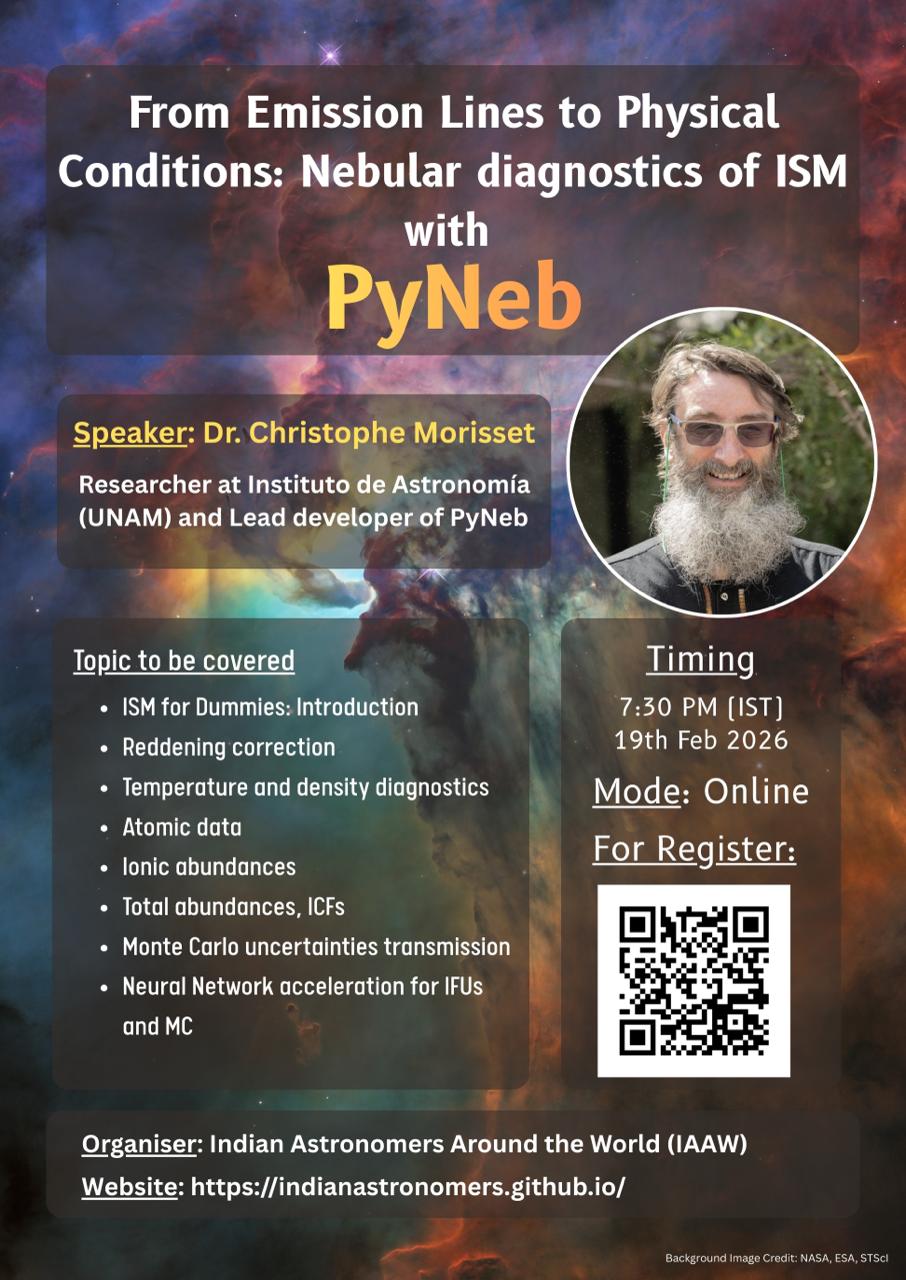
From Emission Lines to Physical Conditions - Nebular Diagnostics of ISM with PyNeb
Description
Indian Astronomers Around the World (IAAW) is organizing an online hands-on workshop on PyNeb, a widely used astronomical data analysis tool for analyzing emission lines and physical conditions of ISM.
The session will include conceptual discussions along with practical guidance on using PyNeb for real data analysis. Time will be reserved for questions and interaction.
Instructor
Dr. Christophe Morisset
Instituto de Astronomía, UNAM, Mexico, Developer of PyNeb
Bio
Dr. Christophe Morisset is an astronomer at the Instituto de Astronomía of the Universidad Nacional Autónoma de México (IA-UNAM), Mexico and a professor of Instituto de Ciencias Fisicas - UNAM, Mexico. Dr. Morisset obtained his PhD in 1996 at the Paris-Meudon observatory (France), with a thesis supervised by Prof. Daniel Pequignot on characterizing the nebular emission of nova ejecta. He later completed postdoctoral stays in Marseille and Sao Paulo (Brazil) until 2003, when he joined the IA-UNAM staff in Mexico City as an associate researcher. In 2018 he moved to the IA-UNAM headquarters in Ensenada, Baja California.
His line of research is mainly linked to the development of theoretical models of ionized nebulae for the analysis of their emission and the determination of their characteristics. To achieve these studies, he has developed original methods. In particular, he has developed the pyNeb and pyCloudy libraries; the former is a set of tools to calculate atomic line emission for abundance calculations and is widely used in the field, the latter is an interface to the Cloudy photoionization code (Ferland et al. 2017) that allows the generation of 3D models or large model samples. Recently, Dr. Morisset has used this latter library for the development of the Mexican Million Models dataBase (3MdB, Morisset et al. 2014), where more than 2 million photoionization and shock models have been registered and are publicly and easily accessible for many theoretical studies. Dr. Morisset collaborates with several research groups, both in the study of individual objects such as Planetary Nebulae or star-forming regions, and in the study of large samples of such objects for statistical analysis. He is part of the team studying nearby galaxies with the CALIFA survey (Sánchez et al., Morisset 2016) or the survey SIGNALS (Rousseau-Nepton et al., 2018).
Outline of the workshop
- ISM for Dummies: Introduction
- Reddenning Correction
- Temperature and Density Diagnostics
- Atomic Data
- Ionic Abundances
- Total Abundances, ICFs
- Monte Carlo uncertainities transmission
- Neural Network acceleration for IFUs and MC
Date & Time
- Date: 19 February 2026
- Time: 07:30 PM (IST)
Mode
Online
Registration
Registraton is closed now. The event is over. For event video, check this 👉 Youtube Link
Target Audience
- PhD students
- Postdoc researchers
- Early-career researchers
- Researchers working on emission-line spectroscopy across cosmic scales: from H II regions and planetary nebulae to star-forming galaxies and the extragalactic ISM
Prerequisites
- Laptop or desktop computer
Resources
Resources
-
Youtube Link of the event.
- PyNeb Website
- PyNeb Documentation
- Publicatons:
- PyNeb: Analysis of emission lines (Luridiana et al. 2013)
- PyNeb: a new tool for analyzing emission lines I. Code description and validation of results (Luridiana et al. 2015)
- Atomic Data Assessment with PyNeb (Morisset et al. 2020)
- Atomic Data Assessment with PyNeb: Radiative and Electron Impact Excitation Rates for [Fe II] and [Fe III] (Mendoza et al. 2023)
Event Poster
Organizers
Indian Astronomers Around the World